The tank force was primarily under the command of the IJA, and not the navy. Also, due to the nature of the Pacific theater, were operations mostly involved small islands ill-suited for tanks, these were deployed only in several large scale operational areas, were they could be effective in blitzkrieg-style tactics. These include China, the Philippines, Burma, Indonesia (Java), while some were dispersed in support of infantry units on Okinawa, Iwo Jima and several other islands. On December 22, near Damortis, on Luzon island (Philippines) the first clash between Japanese and US tanks occurred. They were opposed to M3 and M2A4 light tanks of the American 192nd Tank Battalion. The 57 mm (2.24 in) gun of the Chi-Ha, then the best frontline IJA tank, proved useless against their armor. In Burma, engaging second and third rate light tanks, and a few Stuarts from the 2nd Royal Tank Regiment, the Japanese proved deadly. By 1943, the SNLF, or Navy Armored Force, received its first amphibious tanks, like the Ka-Mi. 223 units would be built until 1945. The Germans sent two Panzer IIIs to Japan, followed later by plans of their more advanced tanks. However, upgrades were slow to appear and the development of really effective German-style tanks never really materialized. Only a few of these new types were completed by 1945, and many prototypes never entered production. Lacking materials and petrol, Japan’s industrial capacities were hampered to the point of complete inefficiency.
The last tanks built were allocated to home defense units, waiting for the invasion (operation Olympic), which never came. When the Soviets invaded Manchuria in August 1945, they found an impressive tank force, at least on the paper, but a deep ravine separated the IJA and Soviet types. The latter had constantly improved their models in response to German tanks, and were much more advanced in speed, firepower and protection than the average IJA models, which were light and/or obsolete by any standards of the time.
It has to be said that the Japanese never had the capacity to develop large-scale production, at least comparable to the western powers. Even during the war, the US naval blockade, mostly performed by the US Navy Air Force and submarines, began to be felt in 1943. By late 1944, Japan was deprived of all kinds of industrial resources, previously taken from south-east Asia, and their industries were constantly hammered by swarms of B-29 bombers operating from China, and later from Iwo Jima and Okinawa. Production efforts were split between the needs of the Army and Navy, leading to many specifications and many proposed vehicles, almost all never surpassing the prototype or pre-series stages.

O-I super-heavy tank
O-I was the name given to a proposed series of Japanese super-heavy tanks, to be used in the Pacific Theater. The vehicle was to be very heavy, and carry 11 crewmen. The exact development status of the O-I is unknown.
After the Battles of Khalkhin Gol against the Soviet Union in 1939, Japan tried to improve their tank designs using lessons learned from this battle. Many Japanese tanks such as the Type 95 Ha-Go light tank and the Type 97 Chi-Ha medium tanks were proven to be insufficient to counter Soviet armored forces. A larger tank design was urgently needed. A super heavy tank project was proposed directly in response to the Japanese defeat at Khalkhin Gol.[2]
In early 1940, Hideo Iwakuro, a colonel with the Army Ministry of Japan (陸軍省 Rikugun-shō) ordered the Army Engineering Division to develop a new super heavy tank. Colonel Iwakuro indicated that the new tank should be at least two times larger than the current Type 95 Heavy Tank (26 tonnes). The general outer appearance design was not dissimilar to the Type 95 Heavy Tank.[2] The proposed 100 ton prototype was to be equipped with a Type 92 105 mm cannon for its main gun.[2]
The development process was re-started by the Mitsubishi Heavy Industries Tokyo Machinery Division on the 120 ton version under the designation "Mi-To" (for Mitsubishi -Tokyo). Later it was given the official designation of the "O-I tank" (オイ車, "オ" in Japanese this means "large" and "イ" means "one"). The tank was again to be equipped with a Type 92 105 mm cannon for its main gun.[2] Its two smaller front hull turrets were designed to be "offset slightly left from the mid-point".[3] One turret was designed to carry a Type 1 47 mm tank gun as secondary armament. The other turret was to carry a 7.7 mm machine gun. The rear hull was designed to have two more smaller turrets each with a 7.7 mm machine gun.[2]
One of the main features of the O-I tank was its thick armor. Its armor had a maximum thickness of up to 200 mm, as well as 35 mm +75 mm plates on its sides and 150 mm at the back.[2][1] The tank was to have two V-12 petrol-fueled aircraft engines designed by BMW in Germany and licensed to Kawasaki Heavy Industries in Japan. This was the same engine used in the Type 5 Chi-Ri medium tank.[2][4] The engines were mounted "lengthwise parallel to each other" in the rear hull.[2]
According to historian Steven Zaloga, there were "rumors that work was underway" on the 120-ton version, but no known documentation survived the war.[5] According to Akira Takizawa, one prototype of 120 tons was completed in 1943. However, the tank was "unpractical" and the project terminated.[1] According to Kenneth Estes, the O-I project was cancelled before the 120+ ton prototype was completed.[3] The tracks of O-I tank are now on display at JGSDF Fuji School in Japan. The exact development status of the O-I prototype is therefore unknown.
According to another source, the model kit company FineMolds in Japan bought original documents and plans of the O-I, which did survive the war. The source also contends that the proposed 100 ton design and "140-150" ton design are "incorrect representations of the O-I".
Shi-Ki
The Type 97 Chi-Ha was Imperial Japan’s most produced and most used medium tank and, as such, many variants were based on its chassis. The Shi-Ki Command tank (コマンドタンクシキ, Komandotankushiki) was one such derivative.
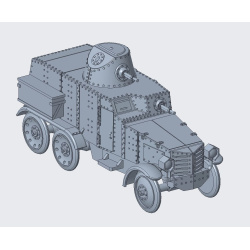
Chiyoda armored car
Design started in 1930 at the Chiyoda Motor Car Factory of Tokyo Gasu Denki K. K. (Tokyo Gas and Electric Industries, today Hino Motors Ltd.) based on their Type Q 6-wheeled truck under the development designation "Type QSW".[1] It had a 4 cylinder petrol engine that produced 75 power hp and a weight ratio of 13.4 hp/t.
The armour scheme and wheel arrangement was similar to the Wolseley armoured car, which had been used by the army. The four spoke wheels of the Wolseleys were replaced by six disk wheels with solid rubber tires. The turret had a cylindrical base with a sloped (in the driving direction) right upper part. A machine gun mount was placed in this sloped section for air defense. Another MG mount was placed in the front of the turret and a third in the left bow. In addition three gun–visor ports were positioned on each side of the fighting compartment. It had a crew of five, consisting of a driver, three gunners and a commander. Armament consisted of three Type 11 6.5 mm machine guns.
Aichi 96 AI_96 Heavy Tank
Aichi 96. Designed sometime after the Type95 heavy tank, Japan delved into producing new tanks in an attempt to fielding them across China. Multiple companies are listed to have taken part. This tank had at least unit built on February 1st, 1937. The Aichi 96 was equipped with 4 cannons, two in the turret, and two in the front hull. The tank was later changed to mount a single 75mm tank gun in the turret.
Type 1 Ho-Ki armored personnel carrier
The Type 1 Ho-Ki was produced as a result of a request from the army for a heavy armored artillery tractor, which could also serve as a personnel transport in order to increase the motorization and cross-country capabilities of the land forces. Several prototypes were built. The first one built on a Type 92 tankette chassis was known as the Type TC. The second prototype built was known as the Type TE. Development of both tracked and half-track APCs intensified in 1941, with two production versions confusingly designated “Type 1" (see the Type 1 Ho-Ha half-track).
Type 91 So-Mo Armoured Car
The Type 91 So-Mo (Japanese: Kyū isshiki kōki ken'in-sha) was a bimodal road-rail armored car adopted by the Imperial Japanese Army in 91. It was characterized by the possibility of moving indifferently on railway tracks and on the road.
Type 3 Ka-Chi amphibious medium tank
The Special Type 3 Launch Ka-Chi (特三式内火艇 カチ, Toku-san-shiki uchibitei Ka-Chi) was an amphibious medium tank developed by the Imperial Japanese Navy in World War II. The Type 3 Ka-Chi was based on an extensively modified Imperial Japanese Army Type 1 Chi-He medium tank (it had 2 more road-wheels and two more return rollers on each side) and was a larger and more capable version of the earlier Type 2 Ka-Mi amphibious tank.
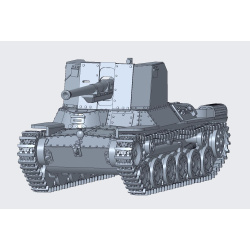
Type 1 Ho-Ni I, II, III
The Type 1 Gun tank Ho-Ni I (一式砲戦車 ホニ I Isshiki ho-sensha Ho-Ni I) was a tank destroyer and self-propelled artillery developed by the Imperial Japanese Army for use during World War II in the Pacific theater.
The Type 1 Ho-Ni I was the first self-propelled gun design of this particular type. They were meant to be self-propelled artillery and tank destroyers for armored divisions. The plan was for the Type 1 Ho-Ni I gun tank to form part of a fire support company in each of the tank regiments. The first conversion took place in June, 1941. Production of the Type 1 Ho-Ni I took place during 1942. The total number of Type 1 Ho-Ni I units produced was only 26.
The Type 1 Ho-Ni I was developed by using the existing Type 97 chassis and engine, and replacing the gun turret with a 75 mm Type 90 Field Gun mounted in an open casemate with frontal and side armour only. The gun mounting gave ten degrees of traverse and -5 to +25 degrees of elevation; it could also traverse 20 degrees to either side, so the entire vehicle did not have to be turned. The Type 1 Ho-Ni I carried 54 rounds of ammunition.[6]
They were designed to operate as self-propelled artillery at ranges of up to 12,000 metres (7.5 mi).[6] The design had no provision for a defensive machine gun, which together with the open structure made it vulnerable in close combat.[6]
The Type 97 chassis, suspension and diesel engine were used unchanged. The 75 mm Type 90 Field Gun, was protected on three sides by 51 mm thick armored plate. The hull armored plate was 25 mm on the sides and 20 mm on the rear.
Type 4 Ka-Tsu amphibious landing craft
The special Type 4 Launch Ka-Tsu (特四式内火艇 カツ, toku-yon-shiki uchibitei Ka-Tsu) was a Japanese amphibious landing craft of World War II. The first prototype was completed in late 1943 and trials were conducted off Kure in March 1944.
Type 93 Kokusan armoured car
The Type 93 armoured car (九三式装甲自動車) was an armoured car used by the Empire of Japan both before and during World War II in China.
Kurogane Type 95 scout car
The Type 95 was a Japanese scout car built by Tokyu Kurogane Industries (東急くろがね工業, Tōkyū Kurogane Kōgyō), and was used during the war with China and World War II in the East. Between 1936 and 1944 approximately 4,700 were built. It was the only completely Japanese designed reconnaissance car ever used by the Imperial Japanese Army, which tended to use civilian cars. Its nickname is the "Yonki" (よんき) which in Japanese means "all-wheel drive". In the field, soldiers often called it the "daruma" after the Buddhist symbol for good luck.
Type 98 Ke-Ni light tank
The Type 98 light tank Ke-Ni (九八式軽戦車 ケニ, Kyuhachi-shiki keisensha Ke-Ni) or Type 98A Ke-Ni Ko (also known as Type 98 Chi-Ni light tank) was designed to replace the Imperial Japanese Army's Type 95 Ha-Go light tank, Japan's most numerous armored fighting vehicle during World War II. Although designed before World War II began, production did not start until 1942, with 104 being produced by the end of the war in the Pacific.
Type 3 Chi-Nu medium tank
Type 3 Medium Tank Chi-Nu (三式中戦車 チヌ, San-shiki chū-sensha Chi-nu, "Imperial Year 2603 Medium tank Model 10") was a medium tank of the Imperial Japanese Army in World War II. Like the Type 1 Chi-He, this tank was an improved version of the Type 97 Chi-Ha. It incorporated a Type 3 75 mm tank gun, one of the largest Japanese tank guns during the war.
Type 97 Chi-Ha medium tank
The Type 97 Chi-Ha (九七式中戦車 チハ, Kyūnana-shiki chū-sensha Chi-ha) was a medium tank used by the Imperial Japanese Army during the Second Sino-Japanese War, the Battles of Khalkhin Gol against the Soviet Union, and the Second World War. It was the most widely produced Japanese medium tank of World War II.
Type 1 Chi-He medium tank
The Type 1 medium tank Chi-He (一式中戦車 チへ, Ichi-shiki chusensha Chihe) was an improved version of the Type 97 Chi-Ha medium tanks of the Imperial Japanese Army in World War II. It had a more powerful main gun, engine and thicker armor. It was the first Japanese tank to have a communication radio as standard equipment. Production of the tank did not begin until 1943, due to the higher priority of steel allocated to the Imperial Navy for warship construction. A total of 170 units were built. All of the tanks produced were allocated for the defense of the Japanese home islands, against the anticipated Allied Invasion.
Type 5 Chi-Ri medium tank
The Type 5 medium tank Chi-Ri (五式中戦車 チリ, Go-shiki chusensha Chi-ri) ("Imperial Year 2605 Medium Tank Model 9") was a medium tank developed by the Imperial Japanese Army in World War II. It was intended to be a heavier, more powerful version of Japan's prototype Type 4 Chi-To medium tank. Only one incomplete prototype was built.
Type 2 Ke-To light tank
The Type 2 Ke-To (二式軽戦車 ケト, Nishiki keisensha Ke-To) was a light tank of World War II, produced in small numbers for the Imperial Japanese Army as an improvement of the existing Type 98 Ke-Ni. No Type 2 Ke-To light tanks are known to have engaged in combat prior to Japan's surrender at the end of World War II.


