
WWII Vehicles
Tanks were an important weapons system in World War II. Even though tanks in the inter-war years were the subject of widespread research, production was limited to relatively small numbers in a few countries. However, during World War II most armies employed tanks, and production levels reached thousands each month. Tank usage, doctrine and production varied widely among the combatant nations. By war's end, a consensus was emerging regarding tank doctrine and design.


ZIS-5 (truck)
The ZIS-5 (Russian: ЗИС-5) was a 4x2 Soviet truck produced by Moscow ZIS factory from 1932 to 1948 (first one made at the end of 1930).

M42 Semovente (75 L18, 75 L34 and Carro Commando Variants)
The Semovente da 75/18 was an Italian self-propelled gun of the Second World War. It was built by mounting the 75 mm Obice da 75/18 modello 34 mountain gun on the chassis of a M13/40, M14/41 or M15/42 tank. The first 60 were built using the M13/40 chassis and a subsequent 162 were built on the M14/41 chassis from 1941 to 1943, when the M15/43 chassis were introduced. The Semovente da 75/18 was intended to be an interim vehicle until the heavier P40 tank could be available.

Sexton II family self-propelled artillery
The 25pdr SP, tracked, Sexton was a self-propelled artillery vehicle of the Second World War. It was based on Canadian-built derivatives of the American M3 Lee and M4 Sherman tank chassis. Canada had setup to produce the Ram tank using the M3 chassis and Grizzly (a copy of the M4) to complement US medium tank production; when Sherman production in the US expanded and supply was no longer a problem, it was decided in 1943 to switch the Canadian production lines to produce the Sexton to give the British Army a mobile artillery gun using their 87.6 mm (3.45 in) Ordnance QF 25 pounder gun-howitzer for commonality with towed guns. The Sexton could fire either HE shell or an armour-piercing shell. It found use in the Canadian and British Army, as well as numerous other British Empire and associated forces. Just after the war, a number of Grizzly and Sextons were sold to Portugal, who used them into the 1980s.
Variants
Sexton II mid (headlights on glacis) (open & covered)
Sexton II late (headlights on front shield) (open & covered)
Variants
Sexton II mid (headlights on glacis) (open & covered)
Sexton II late (headlights on front shield) (open & covered)
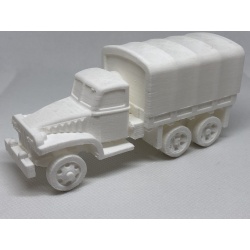
GMC CCKW 2½-ton 6x6 truck (swb & lwb)
The GMC CCKW also known as "Jimmy" was a 2½-ton 6x6 U.S. Army cargo truck that saw heavy service in both World War II and the Korean War. The original "Deuce and a Half", it formed the backbone of the famed Red Ball Express that kept Allied armies supplied as they pushed eastward after the Normandy invasion.
The CCKW came in many variants, including open or closed cab, long wheel base (LWB 353) and short (SWB 352), and over a score of specialized models. It began to be phased out with the deployment of the 6×6 M35 in 1950, but remained in active U.S. service until the mid-1960s. It is related to the Chevrolet G506, built at the same factory.

Aichi 96 AI_96 Heavy Tank
Aichi 96. Designed sometime after the Type95 heavy tank, Japan delved into producing new tanks in an attempt to fielding them across China. Multiple companies are listed to have taken part. This tank had at least unit built on February 1st, 1937. The Aichi 96 was equipped with 4 cannons, two in the turret, and two in the front hull. The tank was later changed to mount a single 75mm tank gun in the turret.