
TigerAce
![]()


The Entwicklung series (from German Entwicklung, "development"), more commonly known as the E-Series, was a late-World War II attempt by Nazi Germany to produce a standardised series of tank designs. There were to be standard designs in five different weight classes (E-10, E-25, E-50, E-75 and E-100) from which several specialised variants were to be developed. This intended to reverse the trend of extremely complex tank designs that had resulted in poor production rates and mechanical unreliability.
The E-series designs were simpler, cheaper to produce and more efficient than their predecessors; however, their design offered only modest improvements in armour and firepower over the designs they were intended to replace, such as the Jagdpanzer 38(t), Panther Ausf.G or Tiger II; and would have represented the final standardization of German armoured vehicle design. Indeed, nearly all of the E-series vehicles — up through and including the E-75 — were intended to use what were essentially the Tiger II's eighty centimeter diameter, steel-rimmed road wheels for their suspension, meant to overlap each other (as on the later production Tiger I-E and Panther designs that also used them), abandoning the interleaved Schachtellaufwerk roadwheel system that first appeared on German military half-tracks in the early 1930s.

The Entwicklung series (from German Entwicklung, "development"), more commonly known as the E-Series, was a late-World War II attempt by Nazi Germany to produce a standardised series of tank designs. There were to be standard designs in five different weight classes (E-10, E-25, E-50, E-75 and E-100) from which several specialised variants were to be developed. This intended to reverse the trend of extremely complex tank designs that had resulted in poor production rates and mechanical unreliability.
The E-series designs were simpler, cheaper to produce and more efficient than their predecessors; however, their design offered only modest improvements in armour and firepower over the designs they were intended to replace, such as the Jagdpanzer 38(t), Panther Ausf.G or Tiger II; and would have represented the final standardization of German armoured vehicle design. Indeed, nearly all of the E-series vehicles — up through and including the E-75 — were intended to use what were essentially the Tiger II's eighty centimeter diameter, steel-rimmed road wheels for their suspension, meant to overlap each other (as on the later production Tiger I-E and Panther designs that also used them), abandoning the interleaved Schachtellaufwerk roadwheel system that first appeared on German military half-tracks in the early 1930s.

The Saladin also spawned an armoured personnel carrier counterpart, the Alvis Saracen. Despite the vehicle's age and dated design, it is still in use in a number of countries in secondary roles.

The Entwicklung series (from German Entwicklung, "development"), more commonly known as the E-Series, was a late-World War II attempt by Nazi Germany to produce a standardised series of tank designs. There were to be standard designs in five different weight classes (E-10, E-25, E-50, E-75 and E-100) from which several specialised variants were to be developed. This intended to reverse the trend of extremely complex tank designs that had resulted in poor production rates and mechanical unreliability.
The E-series designs were simpler, cheaper to produce and more efficient than their predecessors; however, their design offered only modest improvements in armour and firepower over the designs they were intended to replace, such as the Jagdpanzer 38(t), Panther Ausf.G or Tiger II; and would have represented the final standardization of German armoured vehicle design. Indeed, nearly all of the E-series vehicles — up through and including the E-75 — were intended to use what were essentially the Tiger II's eighty centimeter diameter, steel-rimmed road wheels for their suspension, meant to overlap each other (as on the later production Tiger I-E and Panther designs that also used them), abandoning the interleaved Schachtellaufwerk roadwheel system that first appeared on German military half-tracks in the early 1930s.

Design of the Panzer I began in 1932 and mass production began in 1934. Intended only as a training tank to introduce the concept of armored warfare to the German Army, the Panzer I saw combat in Spain during the Spanish Civil War, in Poland, France, the Soviet Union and North Africa during the Second World War, and in China during the Second Sino-Japanese War. Experiences with the Panzer I during the Spanish Civil War helped shape the German Panzerwaffes' invasion of Poland in 1939 and France in 1940. By 1941, the Panzer I chassis design was used as the basis of tank destroyers and assault guns. There were attempts to upgrade the Panzer I throughout its service history, including by foreign nations, to extend the design's lifespan. It continued to serve in the Spanish Armed Forces until 1954.
The Panzer I's performance in combat was limited by its thin armour and light armament of two machine guns. As a design intended for training, the Panzer I was not as capable as other light tanks of the era, such as the Soviet T-26. Although weak in combat, it formed a large part of Germany's tank forces and was used in all major campaigns between September 1939 and December 1941. The small, vulnerable light tank would be surpassed in importance by other German tanks, such as the Panzer IV, Panther, and Tiger; nevertheless, the Panzer I's contribution to the early victories of Nazi Germany during World War II was significant. Later in that war the turrets of the then obsolete PzKpfw Is and PzKpfw IIs were repurposed as gun turrets on specially built defensive bunkers,[3] particularly on the Atlantic Wall.

After the Battles of Khalkhin Gol against the Soviet Union in 1939, Japan tried to improve their tank designs using lessons learned from this battle. Many Japanese tanks such as the Type 95 Ha-Go light tank and the Type 97 Chi-Ha medium tanks were proven to be insufficient to counter Soviet armored forces. A larger tank design was urgently needed. A super heavy tank project was proposed directly in response to the Japanese defeat at Khalkhin Gol.[2]
In early 1940, Hideo Iwakuro, a colonel with the Army Ministry of Japan (陸軍省 Rikugun-shō) ordered the Army Engineering Division to develop a new super heavy tank. Colonel Iwakuro indicated that the new tank should be at least two times larger than the current Type 95 Heavy Tank (26 tonnes). The general outer appearance design was not dissimilar to the Type 95 Heavy Tank.[2] The proposed 100 ton prototype was to be equipped with a Type 92 105 mm cannon for its main gun.[2]
The development process was re-started by the Mitsubishi Heavy Industries Tokyo Machinery Division on the 120 ton version under the designation "Mi-To" (for Mitsubishi -Tokyo). Later it was given the official designation of the "O-I tank" (オイ車, "オ" in Japanese this means "large" and "イ" means "one"). The tank was again to be equipped with a Type 92 105 mm cannon for its main gun.[2] Its two smaller front hull turrets were designed to be "offset slightly left from the mid-point".[3] One turret was designed to carry a Type 1 47 mm tank gun as secondary armament. The other turret was to carry a 7.7 mm machine gun. The rear hull was designed to have two more smaller turrets each with a 7.7 mm machine gun.[2]
One of the main features of the O-I tank was its thick armor. Its armor had a maximum thickness of up to 200 mm, as well as 35 mm +75 mm plates on its sides and 150 mm at the back.[2][1] The tank was to have two V-12 petrol-fueled aircraft engines designed by BMW in Germany and licensed to Kawasaki Heavy Industries in Japan. This was the same engine used in the Type 5 Chi-Ri medium tank.[2][4] The engines were mounted "lengthwise parallel to each other" in the rear hull.[2]
According to historian Steven Zaloga, there were "rumors that work was underway" on the 120-ton version, but no known documentation survived the war.[5] According to Akira Takizawa, one prototype of 120 tons was completed in 1943. However, the tank was "unpractical" and the project terminated.[1] According to Kenneth Estes, the O-I project was cancelled before the 120+ ton prototype was completed.[3] The tracks of O-I tank are now on display at JGSDF Fuji School in Japan. The exact development status of the O-I prototype is therefore unknown.
According to another source, the model kit company FineMolds in Japan bought original documents and plans of the O-I, which did survive the war. The source also contends that the proposed 100 ton design and "140-150" ton design are "incorrect representations of the O-I".


The Tank, Light, Mk VI was the sixth in the line of light tanks built by Vickers-Armstrongs for the British Army during the interwar period. The company had achieved a degree of standardization with their previous five models, and the Mark VI was identical in all but a few respects. The turret, which had been expanded in the Mk V to allow a three-man crew to operate the tank, was further expanded to give room in its rear for a wireless set.[6] The weight of the tank was increased to 10,800 pounds (4,900 kg), which although heavier than previous models actually improved its handling characteristics, and an 88 horsepower (66 kW) engine was added to the model to increase its maximum speed to 35 miles per hour (56 km/h).
It had the Horstmann coil-spring suspension system, which was found to be durable and reliable, although the fact that the tank was short in relation to its width and that it pitched violently on rough ground made accurate gunnery whilst moving exceptionally difficult.[5] The Mk VI possessed a crew of three consisting of a driver, gunner and commander, who also doubled as the radio operator, between 4 millimetres (0.16 in) and 14 millimetres (0.55 in) of armour, which could resist rifle and machine gun bullets, and its armament consisted of one water-cooled .303 inch and one .50 inch Vickers machine gun.

The Tortoise heavy assault tank (A39) was a British heavy assault gun design developed during the Second World War, but never put into mass production. It was developed for the task of clearing heavily fortified areas such as the Siegfried Line and as a result favoured armour protection over mobility.
Although heavy, at 78 tons, and not readily transported, it was considered reliable and a good gun platform.[1]
Only a few prototypes of the Tortoise had been produced by the end of the war.


The SOMUA S35 was a French Cavalry tank of the Second World War. Built from 1936 until 1940 to equip the armoured divisions of the Cavalry, it was for its time a relatively agile medium-weight tank, superior in armour and armament to its French and foreign competitors, such as the contemporary versions of the German Panzerkampfwagen III. It was constructed from well-sloped, mainly cast, armour sections, that however made it expensive to produce and time-consuming to maintain.
During the German invasion of May 1940, the SOMUA S35 proved itself to be a tactically effective type, but this was negated by the French command's strategic mistakes in deploying the Cavalry armoured divisions. After the defeat of France in June 1940, limiting production to a number of about 440, captured SOMUA S35s were used by the Axis powers, some of them on the Eastern Front. A derived type, the SOMUA S40, with an improved suspension, lowered hull cast and welded turret armour, had been planned to replace the original version on the production lines in July 1940. Agreements to produce this improved type for the benefit of Vichy France, Germany and Japan, ultimately did not lead to any manufacture.

The Type 4 15cm self-propelled gun Ho-Ro (日本語: 四式十五糎自走砲 ホロ Imperial Japanese Army Type 4 15cm self-propelled gun Ho-Ro) was a self-propelled gun developed by the Imperial Japanese Army in World War II.
Inspired by the Grille series of self propelled artillery vehicles developed by Nazi Germany during World War II, wherein a 15 cm sIG 33 infantry support gun was mounted on a tracked chassis, engineers at the Army Technical Bureau resolved to do the same. Production was assigned to Mitsubishi Heavy Industries. The exact number produced in 1944 is uncertain, but was approximately 12 units.[2]


A project for an SPG to support light mechanized units. Designed from 1935 through 1937 on the basis of the S35 and S40 vehicles. The design featured a modified upper part of the armored hull with the 75-mm casemate Mle 1929 gun. The top of the cabin featured a single-seated turret with the 7,5-mm Mle 1931 machinegun. The mass production of the SAu 40 was requested in October 1939. A prototype (and, according to some historical sources, four more pilot SAu 40) were sent to the frontline and used in action in June 1940.
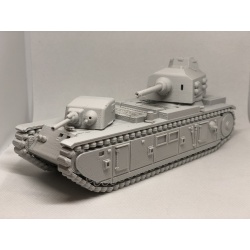

The Char B1 was a French medium tank manufactured before World War II.
The Char B1 was a specialised break-through vehicle, originally conceived as a self-propelled gun with a 75 mm howitzer in the hull; later a 47 mm gun in a turret was added, to allow it to function also as a Char de Bataille, a "battle tank" fighting enemy armour, equipping the armoured divisions of the Infantry Arm. Starting in the early twenties, its development and production were repeatedly delayed, resulting in a vehicle that was both technologically complex and expensive, and already obsolescent when real mass-production of a derived version, the Char B1 "bis", started in the late thirties. Although a second up-armoured version, the Char B1 "ter", was developed, only two prototypes were built.
Among the most powerfully armed and armoured tanks of its day, the type was very effective in direct confrontations with German armour in 1940 during the Battle of France, but slow speed and high fuel consumption made it ill-adapted to the war of movement then being fought. After the defeat of France, captured Char B1 (bis) would be used by Germany, with some rebuilt as flamethrowers, Munitionspanzer, or mechanised artillery.

The Entwicklung series (from German Entwicklung, "development"), more commonly known as the E-Series, was a late-World War II attempt by Nazi Germany to produce a standardised series of tank designs. There were to be standard designs in five different weight classes (E-10, E-25, E-50, E-75 and E-100) from which several specialised variants were to be developed. This intended to reverse the trend of extremely complex tank designs that had resulted in poor production rates and mechanical unreliability.
The E-series designs were simpler, cheaper to produce and more efficient than their predecessors; however, their design offered only modest improvements in armour and firepower over the designs they were intended to replace, such as the Jagdpanzer 38(t), Panther Ausf.G or Tiger II; and would have represented the final standardization of German armoured vehicle design. Indeed, nearly all of the E-series vehicles — up through and including the E-75 — were intended to use what were essentially the Tiger II's eighty centimeter diameter, steel-rimmed road wheels for their suspension, meant to overlap each other (as on the later production Tiger I-E and Panther designs that also used them), abandoning the interleaved Schachtellaufwerk roadwheel system that first appeared on German military half-tracks in the early 1930s.