
TigerAce
![]()


The Entwicklung series (from German Entwicklung, "development"), more commonly known as the E-Series, was a late-World War II attempt by Nazi Germany to produce a standardised series of tank designs. There were to be standard designs in five different weight classes (E-10, E-25, E-50, E-75 and E-100) from which several specialised variants were to be developed. This intended to reverse the trend of extremely complex tank designs that had resulted in poor production rates and mechanical unreliability.
The E-series designs were simpler, cheaper to produce and more efficient than their predecessors; however, their design offered only modest improvements in armour and firepower over the designs they were intended to replace, such as the Jagdpanzer 38(t), Panther Ausf.G or Tiger II; and would have represented the final standardization of German armoured vehicle design. Indeed, nearly all of the E-series vehicles — up through and including the E-75 — were intended to use what were essentially the Tiger II's eighty centimeter diameter, steel-rimmed road wheels for their suspension, meant to overlap each other (as on the later production Tiger I-E and Panther designs that also used them), abandoning the interleaved Schachtellaufwerk roadwheel system that first appeared on German military half-tracks in the early 1930s.

The Entwicklung series (from German Entwicklung, "development"), more commonly known as the E-Series, was a late-World War II attempt by Nazi Germany to produce a standardised series of tank designs. There were to be standard designs in five different weight classes (E-10, E-25, E-50, E-75 and E-100) from which several specialised variants were to be developed. This intended to reverse the trend of extremely complex tank designs that had resulted in poor production rates and mechanical unreliability.
The E-series designs were simpler, cheaper to produce and more efficient than their predecessors; however, their design offered only modest improvements in armour and firepower over the designs they were intended to replace, such as the Jagdpanzer 38(t), Panther Ausf.G or Tiger II; and would have represented the final standardization of German armoured vehicle design. Indeed, nearly all of the E-series vehicles — up through and including the E-75 — were intended to use what were essentially the Tiger II's eighty centimeter diameter, steel-rimmed road wheels for their suspension, meant to overlap each other (as on the later production Tiger I-E and Panther designs that also used them), abandoning the interleaved Schachtellaufwerk roadwheel system that first appeared on German military half-tracks in the early 1930s.

The Entwicklung series (from German Entwicklung, "development"), more commonly known as the E-Series, was a late-World War II attempt by Nazi Germany to produce a standardised series of tank designs. There were to be standard designs in five different weight classes (E-10, E-25, E-50, E-75 and E-100) from which several specialised variants were to be developed. This intended to reverse the trend of extremely complex tank designs that had resulted in poor production rates and mechanical unreliability.
The E-series designs were simpler, cheaper to produce and more efficient than their predecessors; however, their design offered only modest improvements in armour and firepower over the designs they were intended to replace, such as the Jagdpanzer 38(t), Panther Ausf.G or Tiger II; and would have represented the final standardization of German armoured vehicle design. Indeed, nearly all of the E-series vehicles — up through and including the E-75 — were intended to use what were essentially the Tiger II's eighty centimeter diameter, steel-rimmed road wheels for their suspension, meant to overlap each other (as on the later production Tiger I-E and Panther designs that also used them), abandoning the interleaved Schachtellaufwerk roadwheel system that first appeared on German military half-tracks in the early 1930s.

The Tank, Heavy, TOG II* was a prototype British tank design produced in the early part of the Second World War in case the battlefields of northern France devolved into a morass of mud, trenches and craters as had happened during the First World War. When this did not happen the tank was deemed unnecessary and the project terminated. A development of the TOG I design, only a single prototype was built before the project was dropped.
The second design to come out of the Special Vehicle Development Committee (nicknamed "The Old Gang" as it was made up of people who had worked on the original British tanks of the First World War) the TOG 2 was similar to the TOG 1 and kept many of its features. Instead of the track path arrangement of the TOG 1 which - like that of the First World War British tanks - ran up over the top of the hull and back down, the track path was lower on the return run and the doors were above the tracks. Ordered in 1940, built by Foster's of Lincoln, the prototype ran for the first time in March 1941.
The design included a 6-pounder gun and side sponsons. Initially fitted with a mockup turret with a dummy gun, in 1942 it was given a turret that was under development for the Cruiser Mk VIII Challenger tank design with the QF 17-pounder (76.2 mm) gun. The turret "in modified form" was used on the Challenger. The planned sponsons were never fitted.
Although equipped with the same electro-mechanical drive as originally fitted to the TOG 1, the TOG 2 used twin generators and no problems were reported. It was modified to include, among other things, a change from the unsprung tracks to a torsion bar suspension and went through successful trials in May 1943. No further development occurred, although a revised version, the TOG 2 (R) was proposed. The 'R' would have been 6 ft (1.8 m) shorter, used torsion bar suspension and had no sponsons.
The single TOG 2 prototype can be seen at The Tank Museum

The M4 Sherman evolved from the M3 Medium Tank,[N 1] which had its main armament in a side sponson mount. The M4 retained much of the previous mechanical design, but put the main 75 mm gun in a fully traversing turret. One feature, a one-axis gyrostabilizer, was not precise enough to allow firing when moving but did help keep the reticle on target, so that when the tank did stop to fire, the gun would be aimed in roughly the right direction.[6] The designers stressed mechanical reliability, ease of production and maintenance, durability, standardization of parts and ammunition in a limited number of variants, and moderate size and weight. These factors, combined with the Sherman's then-superior armor and armament, outclassed German light and medium tanks fielded in 1939–42. The M4 went on to be produced in large numbers. It spearheaded many offensives by the Western Allies after 1942.

The M4 Sherman evolved from the M3 Medium Tank,[N 1] which had its main armament in a side sponson mount. The M4 retained much of the previous mechanical design, but put the main 75 mm gun in a fully traversing turret. One feature, a one-axis gyrostabilizer, was not precise enough to allow firing when moving but did help keep the reticle on target, so that when the tank did stop to fire, the gun would be aimed in roughly the right direction.[6] The designers stressed mechanical reliability, ease of production and maintenance, durability, standardization of parts and ammunition in a limited number of variants, and moderate size and weight. These factors, combined with the Sherman's then-superior armor and armament, outclassed German light and medium tanks fielded in 1939–42. The M4 went on to be produced in large numbers. It spearheaded many offensives by the Western Allies after 1942.

The KV tanks were practically immune to the 3.7 cm KwK 36 and howitzer-like, short barreled 7.5 cm KwK 37 guns mounted, respectively, on the early Panzer III and Panzer IV tanks fielded by the invading German forces. Until more effective guns were developed by the Germans, the KV-1 was invulnerable to almost any German weapon except the 8.8 cm Flak gun.[3]
Prior to Operation Barbarossa, about 500 of the over 22,000 tanks then in Soviet service were of the KV-1 type. As the war progressed, it became evident that there was little sense in producing the expensive KV tanks, as the T-34 medium tank performed better (or at least equally well) in all practical respects. In fact the only advantage it had over the T-34/76 was its larger and roomier three-man turret.[4] Later in the war, the KV series became a base for the development of the IS (Iosif Stalin) series of tanks and self-propelled guns.
KV-1
- Model 1939 – First production models, these tanks were prone to frequent breakdowns, but were highly resistant to anti-tank weapons during the Winter War. Armed with the 76 mm L-11 tank gun, recognizable due to a recuperator above a barrel. Most tanks were lacking the hull machine gun. 141 were built.
- Model 1940 (German designation: KV-1A) – Used the F-32 76 mm gun and a new mantlet. The main production model by the time of the German invasion.
- Model 1940 s ekranami ("with screens") or KV-1E – with additional bolted-on appliqué armour and F-32 gun.
- Model 1941 (German designation: KV-1B) – Up-armoured with 25–35 mm (0.98–1.38 in) added to the turret, hull front and sides. Turret was now cast instead of welded. This tank was armed with the longer-barreled ZiS-5, tank gun.
- Model 1942 (German designation: KV-1C) – Fully cast turret with thicker armour or welded turret with thicker armour, again up-armoured, using an improved engine and the 76 mm ZiS-5 tank gun.
- KV-1S – A variant with higher speed, but thinner armour. A new, smaller, cast turret and redesigned rear hull with a new planetary transmission. 1370 built.
- KV-2 (334) – A heavy assault tank with the M-10 152 mm howitzer, the KV-2 was produced at the same time as the KV-1. Due to the size of its heavy turret and gun, the KV-2 was slower and had a much higher profile than the KV-1. Those captured and used by the German Army were known as (Sturm)Panzerkampfwagen KV-II 754(r)[citation needed]. Few were produced due to its combat ineffectiveness, mainly the decreased speed due to the weight of the new gun and turret. Due to an increase in turret weight from the expanded dimensions and a heavier gun, the turret traverse mechanism could work only on level ground.

Outwardly, it was large; but internally, the spaces were cramped with the fighting compartments separated from each other. Some of the turrets obscured the entrance hatches.

The Type 97 Chi-Ha was Imperial Japan’s most produced and most used medium tank and, as such, many variants were based on its chassis. The Shi-Ki Command tank (コマンドタンクシキ, Komandotankushiki) was one such derivative.


The KV tanks were practically immune to the 3.7 cm KwK 36 and howitzer-like, short barreled 7.5 cm KwK 37 guns mounted, respectively, on the early Panzer III and Panzer IV tanks fielded by the invading German forces. Until more effective guns were developed by the Germans, the KV-1 was invulnerable to almost any German weapon except the 8.8 cm Flak gun.[3]
Prior to Operation Barbarossa, about 500 of the over 22,000 tanks then in Soviet service were of the KV-1 type. As the war progressed, it became evident that there was little sense in producing the expensive KV tanks, as the T-34 medium tank performed better (or at least equally well) in all practical respects. In fact the only advantage it had over the T-34/76 was its larger and roomier three-man turret.[4] Later in the war, the KV series became a base for the development of the IS (Iosif Stalin) series of tanks and self-propelled guns.
KV-1
- Model 1939 – First production models, these tanks were prone to frequent breakdowns, but were highly resistant to anti-tank weapons during the Winter War. Armed with the 76 mm L-11 tank gun, recognizable due to a recuperator above a barrel. Most tanks were lacking the hull machine gun. 141 were built.
- Model 1940 (German designation: KV-1A) – Used the F-32 76 mm gun and a new mantlet. The main production model by the time of the German invasion.
- Model 1940 s ekranami ("with screens") or KV-1E – with additional bolted-on appliqué armour and F-32 gun.
- Model 1941 (German designation: KV-1B) – Up-armoured with 25–35 mm (0.98–1.38 in) added to the turret, hull front and sides. Turret was now cast instead of welded. This tank was armed with the longer-barreled ZiS-5, tank gun.
- Model 1942 (German designation: KV-1C) – Fully cast turret with thicker armour or welded turret with thicker armour, again up-armoured, using an improved engine and the 76 mm ZiS-5 tank gun.
- KV-1S – A variant with higher speed, but thinner armour. A new, smaller, cast turret and redesigned rear hull with a new planetary transmission. 1370 built.
- KV-2 (334) – A heavy assault tank with the M-10 152 mm howitzer, the KV-2 was produced at the same time as the KV-1. Due to the size of its heavy turret and gun, the KV-2 was slower and had a much higher profile than the KV-1. Those captured and used by the German Army were known as (Sturm)Panzerkampfwagen KV-II 754(r)[citation needed]. Few were produced due to its combat ineffectiveness, mainly the decreased speed due to the weight of the new gun and turret. Due to an increase in turret weight from the expanded dimensions and a heavier gun, the turret traverse mechanism could work only on level ground.

Designed from 1933 onwards and produced from 1936, the type was intended as an infantry support light tank, equipping autonomous tank battalions, that would be allocated to individual infantry divisions to assist them in executing offensive operations. To this end it was relatively well-armoured but slow and lacking a good antitank-capacity, fitted with a short 37 mm gun. At the outbreak of the war, the antitank-role was more emphasized leading to the development and eventual production from April 1940 of a subtype with a more powerful longer gun, the Renault R40. It was planned to shift new production capacity to the manufacture of other, faster, types, but due to the defeat of France the R35/40 remained the most numerous French tank of the war, about 1685 vehicles having been produced by June 1940. At that moment it had also been exported to Poland, Romania, Turkey and Yugoslavia. For the remainder of the war Germany and its allies would use captured vehicles, some of them rebuilt into tank destroyers.



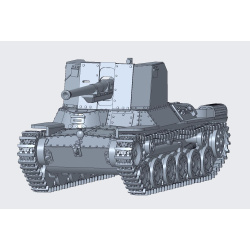
The Type 1 Gun tank Ho-Ni I (一式砲戦車 ホニ I Isshiki ho-sensha Ho-Ni I) was a tank destroyer and self-propelled artillery developed by the Imperial Japanese Army for use during World War II in the Pacific theater.
The Type 1 Ho-Ni I was the first self-propelled gun design of this particular type.[2] They were meant to be self-propelled artillery and tank destroyers for armored divisions.[3][4] The plan was for the Type 1 Ho-Ni I gun tank to form part of a fire support company in each of the tank regiments.[4] The first conversion took place in June, 1941. Production of the Type 1 Ho-Ni I took place during 1942. The total number of Type 1 Ho-Ni I units produced was only 26.[5]
The Type 1 Ho-Ni I was developed by using the existing Type 97 chassis and engine, and replacing the gun turret with a 75 mm Type 90 Field Gun mounted in an open casemate with frontal and side armour only.[5] The gun mounting gave ten degrees of traverse and -5 to +25 degrees of elevation; it could also traverse 20 degrees to either side, so the entire vehicle did not have to be turned.[3] The Type 1 Ho-Ni I carried 54 rounds of ammunition.[6]
They were designed to operate as self-propelled artillery at ranges of up to 12,000 metres (7.5 mi).[5][6] The design had no provision for a defensive machine gun, which together with the open structure made it vulnerable in close combat.[6]
The Type 97 chassis, suspension and diesel engine were used unchanged.[3] The 75 mm Type 90 Field Gun, was protected on three sides by 51 mm thick armored plate. The hull armored plate was 25 mm on the sides and 20 mm on the rear.[7]
