
Bergman
![]()


The Sd.Kfz. 250 (German: Sonderkraftfahrzeug 250; 'special motor vehicle') was a light armoured halftrack, very similar in appearance to the larger Hanomag-designed Sd.Kfz. 251, and built by the DEMAG firm, for use by Nazi Germany in World War II. Most variants were open-topped and had a single access door in the rear.
The Sd. Kfz 250 was adopted in 1939 to supplement the standard halftrack. Production delays meant that the first vehicle did not appear until mid-1941.
Available models:
Sdkfz 250/1 Ausf A ( standard vehicle ) (with/without side bin, with/without mg, with/without mg shield)
Sdkfz 250/3 Ausf A ( command vehicle ) (with/without side bin, with/without mg)
Sdkfz 250/5 Ausf A ( observation post vehicle ) (with/without side bin, with/without mg)
Sdkfz 250/5 Ausf A ( support vehicle, 37mm ) (with/without side bin)

The Panther was intended to counter the Soviet T-34 and to replace the Panzer III and Panzer IV. Nevertheless, it served alongside the Panzer IV and the heavier Tiger I until the end of the war. It is considered one of the best tanks of World War II for its excellent firepower and protection, although its reliability was less impressive.[5]
The Panther was a compromise. While having essentially the same engine as the Tiger I, it had more efficient frontal hull armour,[6] better gun penetration, was lighter and faster, and could traverse rough terrain better than the Tiger I. The trade-off was weaker side armour, which made it vulnerable to flanking fire. The Panther proved to be effective in open country and long range engagements, but did not provide enough high explosive firepower against infantry.[7]
The Panther was far cheaper to produce than the Tiger I, and only slightly more expensive than the Panzer IV. Key elements of the Panther design, such as its armour, transmission, and final drive, were simplifications made to improve production rates and address raw material shortages. The overall design remained somewhat over-engineered.[8][9] The Panther was rushed into combat at the Battle of Kursk despite numerous unresolved technical problems, leading to high losses due to mechanical failure. Most design flaws were rectified by late 1943 and the spring of 1944, though the bombing of production plants, increasing shortages of high quality alloys for critical components, shortage of fuel and training space, and the declining quality of crews all impacted the tank's effectiveness.
Though officially classified as a medium tank, its weight is more like that of a heavy tank, as its weight of 44.8 tons puts it roughly in the same category as the American M26 Pershing (41.7 tons), British Churchill (40.7 tons) and the Soviet IS-2 (46 tons) heavy tanks. The tank had a very high power to weight ratio however, making it extremely mobile regardless of its weight. Its weight still caused heavy tank-esque problems however, such as an inability to cross certain bridges.

The Panther was intended to counter the Soviet T-34 and to replace the Panzer III and Panzer IV. Nevertheless, it served alongside the Panzer IV and the heavier Tiger I until the end of the war. It is considered one of the best tanks of World War II for its excellent firepower and protection, although its reliability was less impressive.[5]
The Panther was a compromise. While having essentially the same engine as the Tiger I, it had more efficient frontal hull armour,[6] better gun penetration, was lighter and faster, and could traverse rough terrain better than the Tiger I. The trade-off was weaker side armour, which made it vulnerable to flanking fire. The Panther proved to be effective in open country and long range engagements, but did not provide enough high explosive firepower against infantry.[7]
The Panther was far cheaper to produce than the Tiger I, and only slightly more expensive than the Panzer IV. Key elements of the Panther design, such as its armour, transmission, and final drive, were simplifications made to improve production rates and address raw material shortages. The overall design remained somewhat over-engineered.[8][9] The Panther was rushed into combat at the Battle of Kursk despite numerous unresolved technical problems, leading to high losses due to mechanical failure. Most design flaws were rectified by late 1943 and the spring of 1944, though the bombing of production plants, increasing shortages of high quality alloys for critical components, shortage of fuel and training space, and the declining quality of crews all impacted the tank's effectiveness.
Though officially classified as a medium tank, its weight is more like that of a heavy tank, as its weight of 44.8 tons puts it roughly in the same category as the American M26 Pershing (41.7 tons), British Churchill (40.7 tons) and the Soviet IS-2 (46 tons) heavy tanks. The tank had a very high power to weight ratio however, making it extremely mobile regardless of its weight. Its weight still caused heavy tank-esque problems however, such as an inability to cross certain bridges.

The Panther was intended to counter the Soviet T-34 and to replace the Panzer III and Panzer IV. Nevertheless, it served alongside the Panzer IV and the heavier Tiger I until the end of the war. It is considered one of the best tanks of World War II for its excellent firepower and protection, although its reliability was less impressive.[5]
The Panther was a compromise. While having essentially the same engine as the Tiger I, it had more efficient frontal hull armour,[6] better gun penetration, was lighter and faster, and could traverse rough terrain better than the Tiger I. The trade-off was weaker side armour, which made it vulnerable to flanking fire. The Panther proved to be effective in open country and long range engagements, but did not provide enough high explosive firepower against infantry.[7]
The Panther was far cheaper to produce than the Tiger I, and only slightly more expensive than the Panzer IV. Key elements of the Panther design, such as its armour, transmission, and final drive, were simplifications made to improve production rates and address raw material shortages. The overall design remained somewhat over-engineered.[8][9] The Panther was rushed into combat at the Battle of Kursk despite numerous unresolved technical problems, leading to high losses due to mechanical failure. Most design flaws were rectified by late 1943 and the spring of 1944, though the bombing of production plants, increasing shortages of high quality alloys for critical components, shortage of fuel and training space, and the declining quality of crews all impacted the tank's effectiveness.
Though officially classified as a medium tank, its weight is more like that of a heavy tank, as its weight of 44.8 tons puts it roughly in the same category as the American M26 Pershing (41.7 tons), British Churchill (40.7 tons) and the Soviet IS-2 (46 tons) heavy tanks. The tank had a very high power to weight ratio however, making it extremely mobile regardless of its weight. Its weight still caused heavy tank-esque problems however, such as an inability to cross certain bridges.

Crews liked the vehicle for its simplicity, reliability, and ease of use. However, the steering was also sometimes regarded as difficult, leading crews to also refer to the vehicle as suka (Russian: сука; "bitch") or suchka (Russian: сучка; "little bitch"). It was also nicknamed Golozhopiy Ferdinand (Russian: Голожопый Фердинанд; "bare-arsed Ferdinand") due to its very light armor and somewhat similar silhouette, when compared to the Germans' heavy Ferdinand/Elefant casemate tank destroyer of some 65 tonnes in weight.

Though the British expected to have their own new tank models developed soon, the previously rejected idea of mounting the 17-pounder in the existing Sherman was eventually accepted, despite initial government resistance. This proved fortunate, as both the Cruiser Mk VIII Challenger and Cruiser Mk VIII Cromwell tank designs experienced difficulties and delays.
After the difficult problem of getting such a large gun to fit in the Sherman's turret was solved, the Firefly was put into production in early 1944, in time to equip Field Marshal Montgomery's 21st Army Group for the Normandy landings. It soon became highly valued, as its gun could almost always penetrate the armour of the Panther and Tiger tanks it faced in Normandy. In recognition of this, German tank and anti-tank gun crews were instructed to attack Fireflies first.[citation needed] Because the Firefly had a visibly longer barrel, crews tried to camouflage it so the tank would look like a normal 75 mm-gun Sherman from a distance. Between 2,100 and 2,200 were manufactured before production wound down in 1945.

In the British naming system, the major variants were identified by Mark numbers, the M4 being "Sherman I", the M4A1 "Sherman II" and so on. Letters after the mark number denoted modifications to the base model: "A" for the 76 mm L/55 gun instead of the 75mm, "B" for the 105 mm M4 L/22.5 howitzer, "C" for the (British) QF 17 pounder (76.2 mm) gun, and "Y" for the later wider-tracked Horizontal Volute Spring Suspension (HVSS) type suspension. Gun and suspension letters were used in combination, e.g. Sherman IBY. However, no production 75mm Shermans were built with HVSS and no HVSS 17pdr conversions (CY) therefore existed. HVSS Shermans were only fitted with 76mm M1 guns or 105mm M4 howitzers, AY and BY respectively in British service.
- Sherman I - M4 with 75 mm M3 L/40 gun and Continental R975 9-cylinder radial petrol engine
- Sherman Hybrid I - Sherman I with composite hull (cast front, welded rear)
- Sherman IB - Sherman I with 105 mm M4 L/22.5 howitzer
- Sherman IBY - Sherman IB with HVSS
- Sherman II - M4A1 with 75 mm M3 L/40 gun and Continental R975 radial petrol engine
- Sherman IIA - M4A1(76)W, Sherman II with 76 mm M1 L/55 gun
- Sherman IIAY - M4A1(76)W HVSS, Sherman IIA with HVSS
- Sherman III - M4A2 with 75 mm M3 L/40 gun and GM6046 twin 6-cylinder diesel engine
- Sherman IIIA - M4A2(76)W, Sherman III with 76 mm M1A2 L/55 gun (unlikely to have been used by UK troops)
- Sherman IIIAY - M4A2(76)W HVSS, Sherman IIIA with HVSS (not used operationally by UK troops)
- Sherman IV - M4A3 with 75 mm M3 L/40 gun (no Sherman IVs used operationally) and Ford GAA V8 petrol engine
- Sherman IVA - M4A3(76)W, Sherman IV with 76 mm M1A2 L/55 gun
- Sherman IVB - M4A3(105), Sherman IV with 105 mm M4 L/22.5 howitzer
- Sherman IVBY - M4A3(105) HVSS, Sherman IVB with HVSS
- Sherman V - M4A4 with 75 mm M3 L/40 gun and Chrysler A57 multibank 30-cylinder "cloverleaf" petrol engine in a longer rear hull with more widely spaced bogies
- Sherman VI - M4A5 (paper designation for Canadian production)
- Sherman VII - M4A6 with 75 mm M3 L/40 gun, composite cast/welded hull and Ordnance RD-1820 9-cylinder radial diesel engine. Only 75 M4A6 were built and none are believed to have reached the UK
- Sherman II ARV III - M32B1 TRV (M4A1 Sherman II chassis) recovery vehicle
- Sherman V ARV III - M32B4 TRV (M4A4 Sherman V chassis) recovery vehicle. Extremely rare, almost mythical, vehicle. Production records are sketchy and British use is uncertain, but a photo does exist of an M32B4 in post-war Greek service

The Humber Armoured Car was one of the most widely produced British armoured cars of the Second World War. It supplemented the Humber Light Reconnaissance Car and remained in service until the end of the war.
Made by the Rootes Group, the Humber was essentially a combination of the Karrier KT 4 artillery tractor chassis and the armoured body of the Guy Armoured Car. The KT4 was already in production for the Indian Army, and Guy were having problems with the production levels required. The Karrier name was dropped to avoid confusion.[3]
The first order for 500 was placed in 1940. The first Humbers were more or less identical to the Guy down to the faults in the armour, but this was later rectified. Production started in 1941.
The Mark III improved upon the Mark II by providing a three-man turret. Mark III production ended in 1942 after 1,650 had been built. With a possible replacement, the 2-pounder armed Coventry armoured car, on its way, the Mark IV was designed. This put the US 37 mm gun in the turret but at the cost of one crewman. The Coventry was not ordered as a replacement and so production of Mark IV continued, for a total of 2,000, despite its flaws.

The Daimler Armoured Car was a successful British armoured car design of the Second World War that continued in service into the 1950s. It was designed for armed reconnaissance and liaison purposes. During the postwar era, it doubled as an internal security vehicle in a number of countries.
Former British Daimler armoured cars were exported to various Commonwealth of Nations member states throughout the 1950s and 1960s. In 2012, some were still being operated by the Qatari Army.


Crews liked the vehicle for its simplicity, reliability, and ease of use. However, the steering was also sometimes regarded as difficult, leading crews to also refer to the vehicle as suka (Russian: сука; "bitch") or suchka (Russian: сучка; "little bitch"). It was also nicknamed Golozhopiy Ferdinand (Russian: Голожопый Фердинанд; "bare-arsed Ferdinand") due to its very light armor and somewhat similar silhouette, when compared to the Germans' heavy Ferdinand/Elefant casemate tank destroyer of some 65 tonnes in weight.


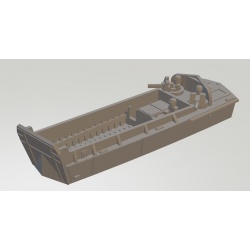
The craft was designed by Andrew Higgins based on boats made for operating in swamps and marshes. More than 23,358 were built, by Higgins Industries and licensees.
Taking the last letter of the LCVP designation, sailors often nicknamed the Higgins Boat the "Papa Boat" or "Peter Boat" to differentiate it from other landing craft such as the LCU and the LCM, with the LCM being called the "Mike Boat."

The basic engineering for all the German half-tracks was developed during the Weimar-era by the Reichswehr's Military Automotive Department, but final design and testing was farmed out to commercial firms with the understanding that production would be shared with multiple companies. Demag was chosen to develop the smallest of the German half-tracks and spent the years between 1934 and 1938 perfecting the design through a series of prototypes.
The chassis formed the basis for the Sd.Kfz. 250 light armored personnel carrier. Approximately 14,000 were produced between 1938 and 1945, making it one of the most widely produced German tactical vehicles of the war. It participated in the Invasion of Poland, the Battle of France, the Balkans Campaign and fought on both the Western Front and the Eastern Front, in North Africa and in Italy.

Derived variants included an elongated version and the four-wheel drive Blitz A. To cope with the bad road conditions and the rasputitsa mud seasons on the Eastern Front, a half-tracked Maultier (mule) SdKfz 3 version was built using tracks and suspension based on the Universal Carrier. Among others, these were used as service vehicles for the Messerschmitt Me 323 military transport aircraft. It is also claimed that Opel, a subsidiary of GM, used forced labor to reap unprecedented profits.[1] To what degree GM controlled Opel at the time is subject to debate, but it is clear that GM did in fact play a role in giving Nazi Germany the Opel Blitz truck.[2]

The Tiger II was the successor to the Tiger I, combining the latter's thick armour with the armour sloping used on the Panther medium tank. The tank weighed almost 70 tonnes, and was protected by 100 to 185 mm (3.9 to 7.3 in) of armour to the front.[9] It was armed with the long barrelled 8.8 cm KwK 43 L/71 anti-tank cannon.[notes 2] The chassis was also the basis for the Jagdtiger turretless tank destroyer.[10]
The Tiger II was issued to heavy tank battalions of the Army and the Waffen-SS. It was first used in combat with 503rd Heavy Panzer Battalion during the Allied Invasion of Normandy on 11 July 1944;[11] on the Eastern Front, the first unit to be outfitted with Tiger IIs was the 501st Heavy Panzer Battalion, which by 1 September 1944 listed 25 Tiger IIs operational.

The IS-3 (also known as Object 703) is a Soviet heavy tank developed in late 1944. Its semi-hemispherical cast turret (resembling an upturned soup bowl), became the hallmark of post-war Soviet tanks. Its pike nose design would also be mirrored by other tanks of the IS tank family such as the IS-7 and T-10. Too late to see combat in World War II, the IS-3 participated in the Berlin Victory Parade of 1945, in the border conflict during the Sino-Soviet split, the Soviet invasion of Hungary, the Prague Spring and on both sides of the Six-Day War.

Like its predecessors, the BA-10 could be converted to a half-track by fitting auxiliary tracks to the rear pair of dual tandem wheels. On early BA-10s, these tracks were stowed strapped on top of the fenders. Later vehicles had an enclosed stowage box for the tracks in the same location. The tracks were often fitted when the vehicle needed to move across snow or soft ground.
BA-3
BA-6
BA-10
BA-10M